
More than 2 tonnes of CO₂ emissions have already been avoided in five months thanks to the RuralMED Mobility pilot implemented in the Bulgarian municipalities of Radnevo and Galabovo. Developed by the Stara Zagora Regional Economic Development Agency in cooperation with both municipalities, the pilot is bringing modern electric mobility infrastructure to two communities located at the heart of Bulgaria’s coal-transition region.
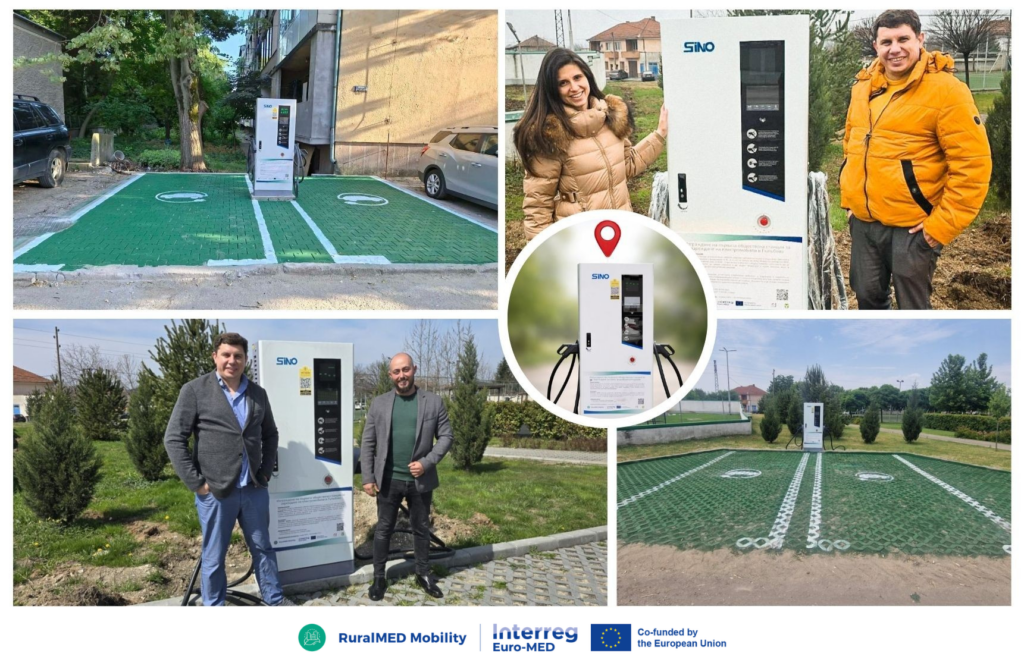
Each municipality now hosts a publicly accessible 50 kW DC fast-charging station, equipped with a universal CCS2 connector compatible with the vast majority of electric vehicles used across Europe. The station in Radnevo is located next to the municipal building in the town centre, while the station in Galabovo serves an important national road corridor. The facilities were officially inaugurated on 25 February 2026 in Radnevo and 31 March 2026 in Galabovo.
Early results show growing demand
As of July 2026, the two charging stations have recorded 98 charging sessions and supplied a total of 2,223.54 kWh of electricity. This corresponds to approximately 13,080 kilometres of electric driving and an estimated 2.11 tonnes of CO₂ emissions avoided.
The pilot has also recently reached another important milestone with the completion of the dedicated parking areas surrounding the charging stations. Finished in a distinctive bright green colour with clear white markings and electric vehicle symbols, the new bays improve the visibility of the facilities, make them easier to identify and reinforce their connection with sustainable mobility.
The charging stations offer several access options, including RFID cards and a mobile application, while real-time monitoring and data exchange are supported through integration with the RuralMED Mobility digital platform.
More than charging infrastructure
The Bulgarian pilot is particularly significant because Radnevo and Galabovo are among the municipalities most affected by the restructuring of Bulgaria’s coal-dependent economy. Their experience demonstrates that demand for electric mobility is not limited to large cities or commercially attractive locations. Even in smaller municipalities facing demographic challenges and limited public resources, well-located and visible charging infrastructure can attract users and generate immediate environmental benefits.
Beyond the encouraging usage figures, the pilot is providing valuable evidence on how electric mobility can support the transition of rural communities towards a more sustainable future. Continued monitoring will help assess charging behaviour, user demand and the potential for similar solutions to be replicated in other rural and transition regions across the Mediterranean.
In Radnevo and Galabovo, the green transition is no longer only a policy objective—it is becoming visible, measurable and part of everyday mobility.